
Coal
Production and exports increased following disruption to transport routes in 2025. Imports also increased as Genesis Energy continued to build its stockpile at the Huntly Power Station.
On this page I tēnei whārangi
Higher renewable generation reduced the need for coal-fired electricity generation compared with 2024. Coal consumption by businesses and households fell to its lowest level on record, with demand declining across all sectors.
Background
There are three different coal types which are produced in New Zealand:
- Bituminous: A higher grade of coal typically extracted from the West Coast of the South Island. Most of this coal is exported for iron and steel production purposes or used in the industrial sector.
- Sub-bituminous: A lower quality coal which can’t be used for metallurgical applications (production of iron and steel). This type of coal is typically extracted from the West Coast, Waikato region or other places in the South Island. The coal burned is used to provide heat for different purposes like drying milk powder, powering steam engines, running boilers, or heating houses.
- Lignite: A lower quality coal compared to sub-bituminous which is produced in the South Island. Lignite has a lower energy content and is generally sold to dairy and meat processing plants in the South Island and to households and companies for heating.
Sub-bituminous coal is used at the Glenbrook steel mill south-east of Auckland. Unlike other steel mills, the Glenbrook mill can use thermal-grade coal in the production of iron and steel due to the unique processes employed at the facility. In the iron and steelmaking process, sub-bituminous coal is used as a reducing agent, converting magnetite in iron sand to metallic iron. While it may provide energy, its primary purpose is as a reagent in a chemical reaction, meaning that it is not classified as energy use.
Another major use of coal in New Zealand is for the Huntly Power Station, which uses the energy in combusted coal to drive turbines which generate electricity.
Production and exports increase following the reopening of major transport routes
In June 2024, the Tawhai Tunnel on the route between the Stockton Mine to Lyttleton Port was closed following a partial collapse. This led to a fall in production and the lowest level of national bituminous coal exports since 1994, as this is a major transport route for moving export-bound coal from the Buller and Reefton coal mines.
The reopening of the tunnel in early 202515 contributed to national coal production in 2025 increasing 4.2% (2.64 PJ) on 2024 levels (Figure D.1). This growth was driven primarily by bituminous coal production, which increased 11% (4.14 PJ). At the same time, sub-bituminous and lignite decreased by 6.6% (1.48 PJ) and 0.6% (0.03 PJ).
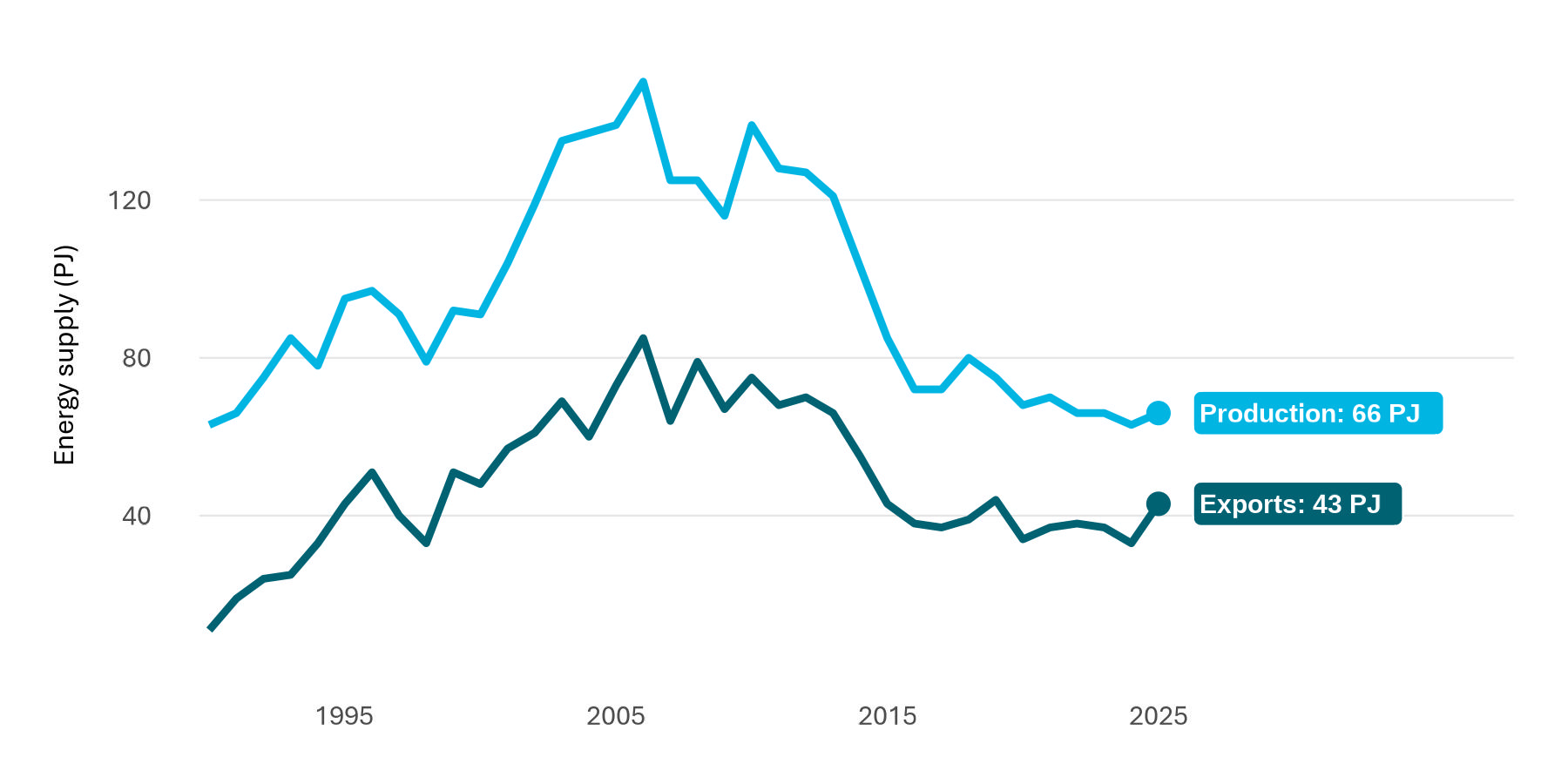
Figure D.1: Total coal production and exports by year.
View chart data for figure D.1
Coal stockpile at Huntly reaches 1 million tonnes
In response to uncertainty around domestic gas supply in 2024, Genesis Energy announced in May 2024 that it would resume imports of sub-bituminous coal to increase the stockpile at the Huntly Power Station (New Zealand’s only coal-fired power plant). Further, in anticipation of a potential need for more coal-fired generation in winter 2025, Genesis continued to increase their imports of sub-bituminous coal. As a result, overall coal imports increased by 29% (6.44 PJ) (Figure D.2) in 2025, with sub-bituminous coal imports up by 38% (7.52 PJ).
This helped increase their stockpile to 1.16 million tonnes by the end of 2025, the highest level since March 201216.
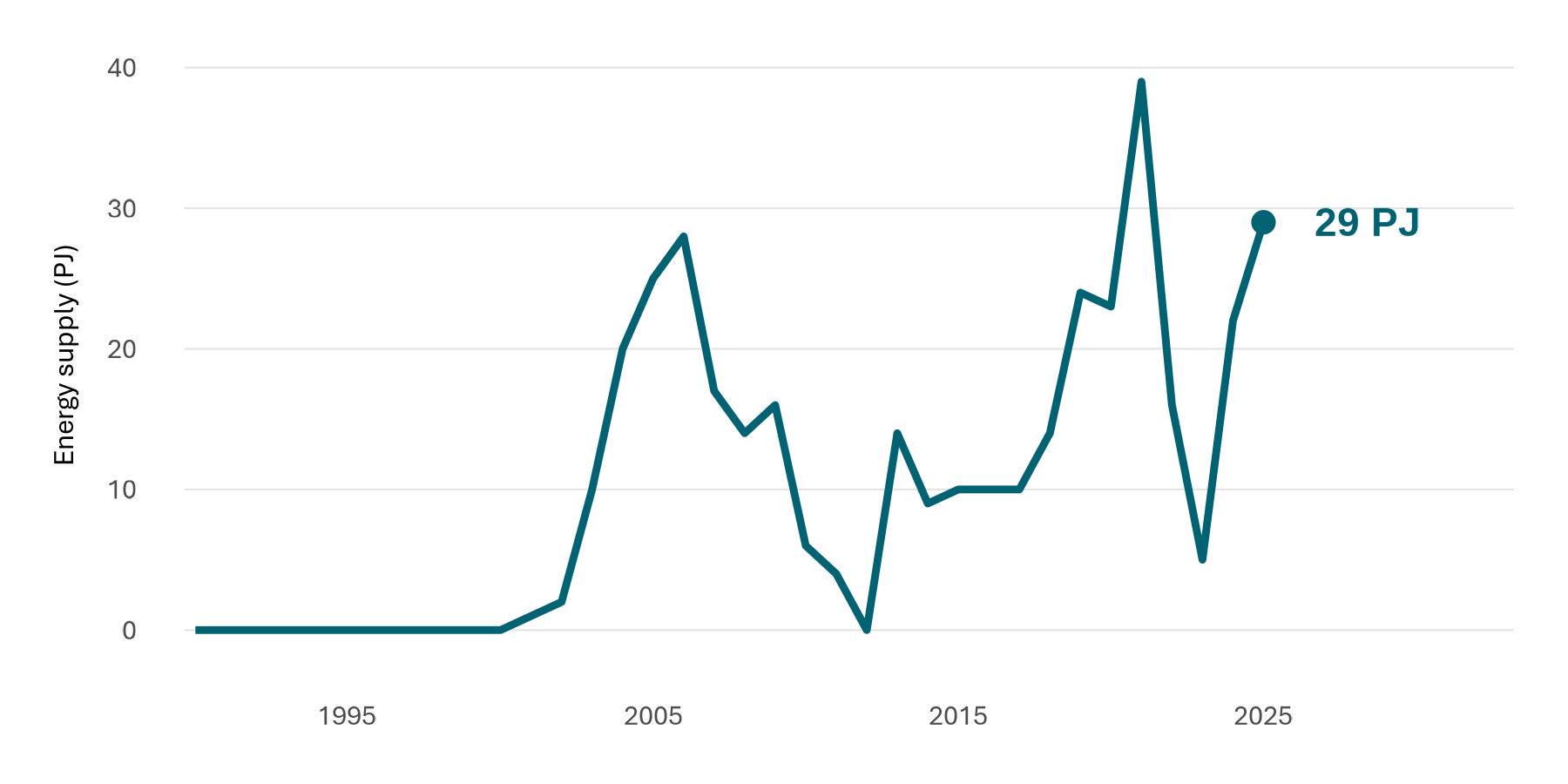
Figure D.2: Total coal imports by year.
View chart data for figure D.2
Dry conditions in 2024 saw an increased use of non-renewable sources for electricity generation. In contrast, 2025 saw more favourable hydro conditions alongside increased output from geothermal and solar generation following capacity additions over recent years. This led to sub-bituminous coal use for electricity generation decreasing by 38% (6.92 PJ), with the December 2025 quarter seeing the lowest sub-bituminous coal use since the June 2023 quarter.
Coal consumption falls to lowest level on record
Overall coal consumption decreased by 17% (2.94 PJ) to 14.3 PJ in 2025, the lowest level on record. Coal consumption declined in all sectors, with the largest decrease observed in the industrial sector, which fell 18% (2.70 PJ).
The decline in industrial coal consumption was driven by the food processing sector, which includes dairy and meat product processing (Figure D.3). This reflects large energy users, such as Fonterra, reducing reliance on coal in their manufacturing processes. Fonterra’s last coal boiler in the North Island was turned off near the end of 2024, and August 2025 saw the conversion of two coal-fired boilers to biomass at their Clandeboye site17.
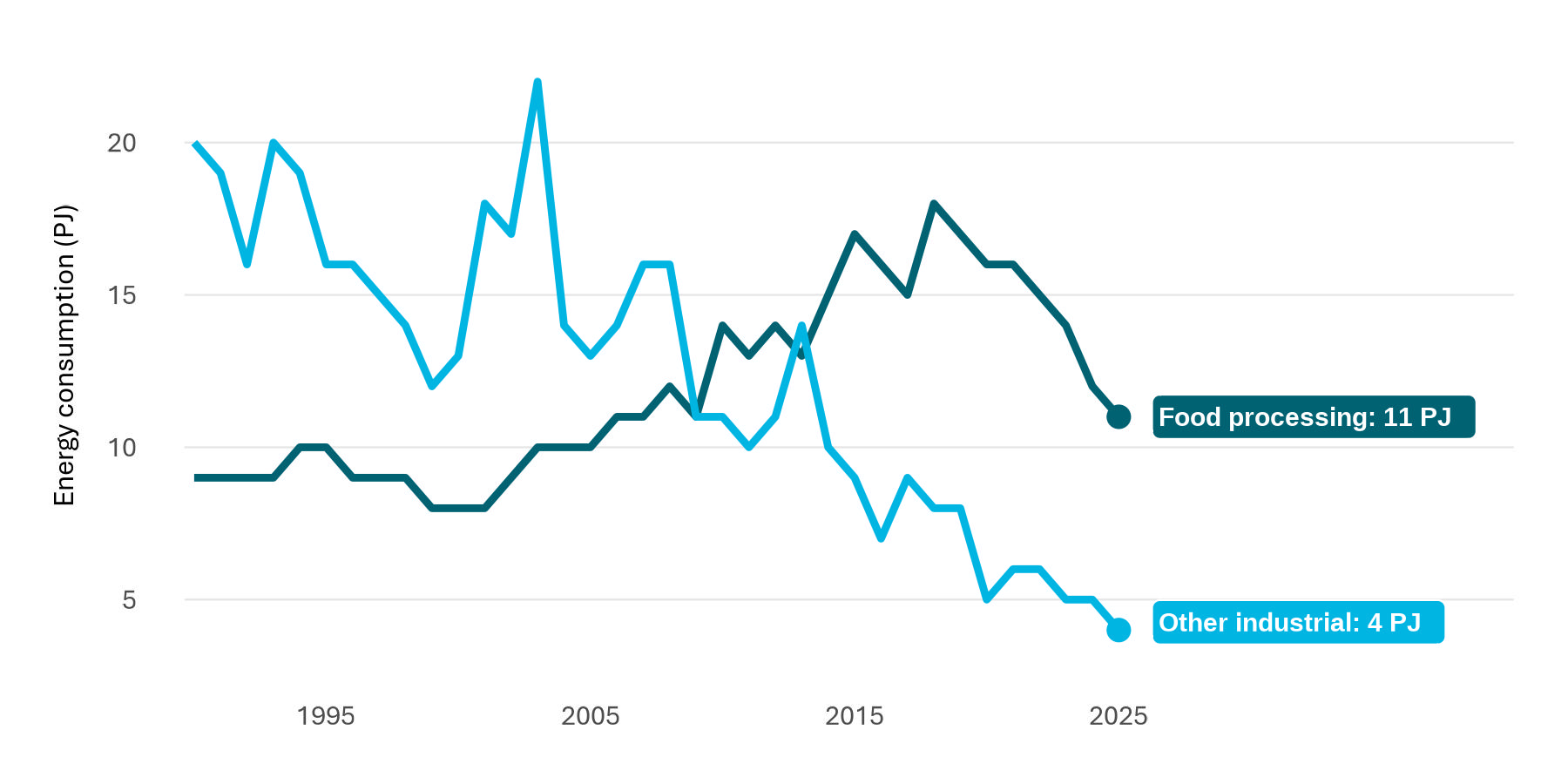
Figure D.3: Coal consumption of the food processing subsector and other industrial sectors by year.
View chart data for figure D.3
Footnotes
[15] 2025 Annual Report(external link) — Bathurst Resources Limited
[16] Interim Report 2026(external link) — Genesis Energy
[17] Fonterra invests $75 million to expand butter production at Clandeboye(external link) — Fonterra