
Māori-Crown relations
MBIE is committed to fulfilling its Treaty settlement commitments and developing and maintaining our capability to engage effectively with Māori and to understand Māori perspectives.
On this page I tēnei whārangi
Te Tāpuhipuhi
As part of our Te Ara Amiorangi collective focus area, MBIE is committed to fulfilling its Treaty settlement commitments in a way that upholds the integrity of settlements and strengthens relationships with iwi and hapū. At the centre of our work to lift economic outcomes, we need to engage with iwi and hapū and continue to do so respectfully and with tikanga. Te Tāpuhipuhi is the strategy that sits underneath Te Ara Amiorangi, which guides our work in this area. This strategy has 4 areas of focus to enable us to do this:
- Māori Crown Capability
- Treaty settlements and obligations
- Engagement with Māori
- Waitangi Tribunal Inquiries and reports.
Treaty settlement commitments
He Korowai Whakamana, a Cabinet-agreed framework, requires core Crown agencies to record and track the status of, and report annually on, their settlement commitments. Te Arawhiti – the Office for Māori Crown Relations was lead agency and responsible for tracking the Crown’s overall progress with delivering on Treaty settlement commitments. In February 2025, functions for post-settlement matters transferred to Te Puni Kōkiri, which now holds the system lead role for oversight and accountability of Treaty settlements.
As part of He Korowai Whakamana, core Crown agencies were also required to report on the status of their settlement commitments from 2023/24.
MBIE, on behalf of the Crown, is responsible for fulfilling various commitments made to iwi groups as part of the settlement of historical Treaty claims. These commitments are recorded in deeds of settlement and Treaty settlement Acts. MBIE has 251 Treaty settlement commitments across 61 settlements:
- 178 commitments relate to minerals under the Crown Minerals Act 1991 or natural resources
- 40 commitments relate to the establishment of Accords, including Iwi–Crown Accords, Energy and Resources Accord as well as Social and Economic Accords
- 2 commitments relate to the establishment of relationship agreements (bilateral and multi-agency) relating to iwi social and economic aspirations
- 21 commitments relate to other miscellaneous commitments, including transfer of land and assets.
As at June 2025, the status of MBIE’s commitments is:
- completed (56% – 140 commitments) – fully delivered according to agreed terms and timeframes
- on track (40% – 100 commitments) – progressing according to planned timelines and meeting milestones; commitments reflect the ongoing nature of relationship-based obligations like Crown Minerals Protocols and Iwi–Crown Accords
- yet to be triggered (2% – 5 commitments) – experiencing delays, typically a result from cross- agency co-ordination challenges or evolving iwi needs requiring updated approaches. The action is to be triggered by another agency or iwi and no further steps required from MBIE at this stage
- delivery issues (2%– 6 commitments) – these are commitments that are not confirmed as completed. These commitments relate to one settlement and the transfer of parcels of land.
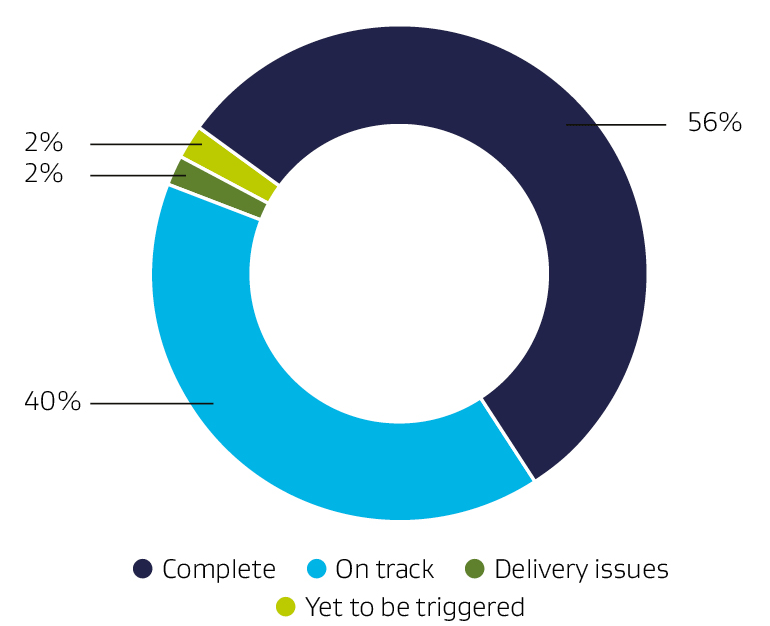
Texr description for graph - Status of Treaty settlement commitments
A significant number of MBIE’s settlement commitments relate to establishing and maintaining ongoing relationships, particularly regarding Crown minerals and resources, and economic and social development.
MBIE has made progress on Treaty settlements through engagement and internal frameworks but must further improve compliance, accountability, leadership, co-ordination and tracking. MBIE’s approach to monitoring, reporting and relationship management ensures continued progress toward full delivery of all commitments while building enduring partnerships with iwi.
Aligning internal systems with recommendations made in the Auditor-General report on How public organisations are fulfilling Treaty settlement will help MBIE meet its obligations and deliver timely benefits to iwi and hapū, supporting trust and partnership. Our work demonstrates that successful Treaty settlement implementation requires sustained attention, adequate resources and genuine partnership with iwi to support their aspirations for their communities.
Whāinga Amorangi and Te Ara Reo Rangatira
The Public Service Act 2020 places explicit responsibilities on Public Service leaders to develop and maintain the capability of the Public Service to engage effectively with Māori and to understand Māori perspectives.
To support the Public Service in meeting these commitments, Te Tari Whakatau – Office of Treaty Settlements and Takutai Moana (formerly Te Arawhiti – Office for Māori Crown Relations) developed and led the implementation of Whāinga Amorangi: Transforming Leadership. This was supported by Te Kawa Mataaho – Public Service Commission, Te Puni Kōkiri – Ministry of Māori Development and Te Taura Whiri i te Reo Māori – Māori Language Commission.
Whāinga Amorangi supports the successful delivery of building and strengthening our people’s capability in Māori–Crown relations. It is both engaging and empowering. The overarching goal of this plan is to enable the successful delivery of Te Ara Amiorangi and Te Tāpuhipuhi by strengthening our partnering capabilities. MBIE is still in Phase 1, and its Whāinga Amorangi Plan outlines the refresh of the collective outcomes for this phase throughout 2024 to 2030. Whāinga Amorangi includes 4 capability areas:
- Te reo Māori
- Te Tiriti o Waitangi/the Treaty of Waitangi and Aotearoa New Zealand history
- Tikanga/customs and kawa/protocols
- Engagement with Māori.
An integral part of Whāinga Amorangi is our Māori language strategy, Te Ara Reo Rangatira. This strategy outlines MBIE’s commitment to supporting the development and use of te reo Māori as a valued and living official language of Aotearoa New Zealand, and the normalisation of te reo Māori at MBIE.