
Offshore renewable energy in New Zealand
Offshore renewable energy is energy generated from a renewable source, such as wind, sunlight, waves or tidal currents, using developments located in, on, or under the sea.
On this page I tēnei whārangi
Why offshore renewable energy matters for New Zealand
The Government wants to diversify New Zealand’s energy supply to deliver affordable, reliable, and sustainable electricity across the country. Offshore renewable energy is a large, untapped resource that can produce electricity on a large scale. Developing it could help grow New Zealand’s economy while providing clean, sustainable electricity.
How offshore renewable energy supports our energy goals
Over 70 percent of New Zealand’s energy use in 2024 came from non-renewable sources.
Energy in New Zealand - Overview
Offshore renewable energy will:
- help reduce our reliance on non-renewable energy sources such as fossil fuels
- support net-zero carbon emissions by 2050
- help to meet our growing energy needs
- improve our energy resilience and independence
- enable greater electrification which plays a key role in decarbonising our energy system and supporting the transition to clean energy.
Types of offshore renewable energy
Offshore renewable energy can be generated from:
- Wind
- Waves
- Tides
- Ocean currents
- Light or heat from the sun
- Rain
- Geothermal heat.
How offshore renewable energy is used around the world
Offshore wind is currently regarded as the most advanced offshore renewable energy technology and is the most proven and widely used at commercial scale.
Many countries, including China, the United Kingdom, Germany and Denmark have operational offshore wind farms. Others have projects which are progressing but are not yet operational.
Worldwide there is over 83GW (83,000 MW) of offshore wind generating capacity already in operation.
Offshore wind installed capacity reaches 83 GW as new report finds 2024 a record year for construction and auctions(external link) — Global Wind Energy Council
China recently constructed an offshore solar farm, and other countries have explored and tested other technologies, such as wave and tidal energy, and are progressing towards commercial scale operation in the near future.
How wind turbines work
Wind turbines convert wind energy into electrical energy in the following way:
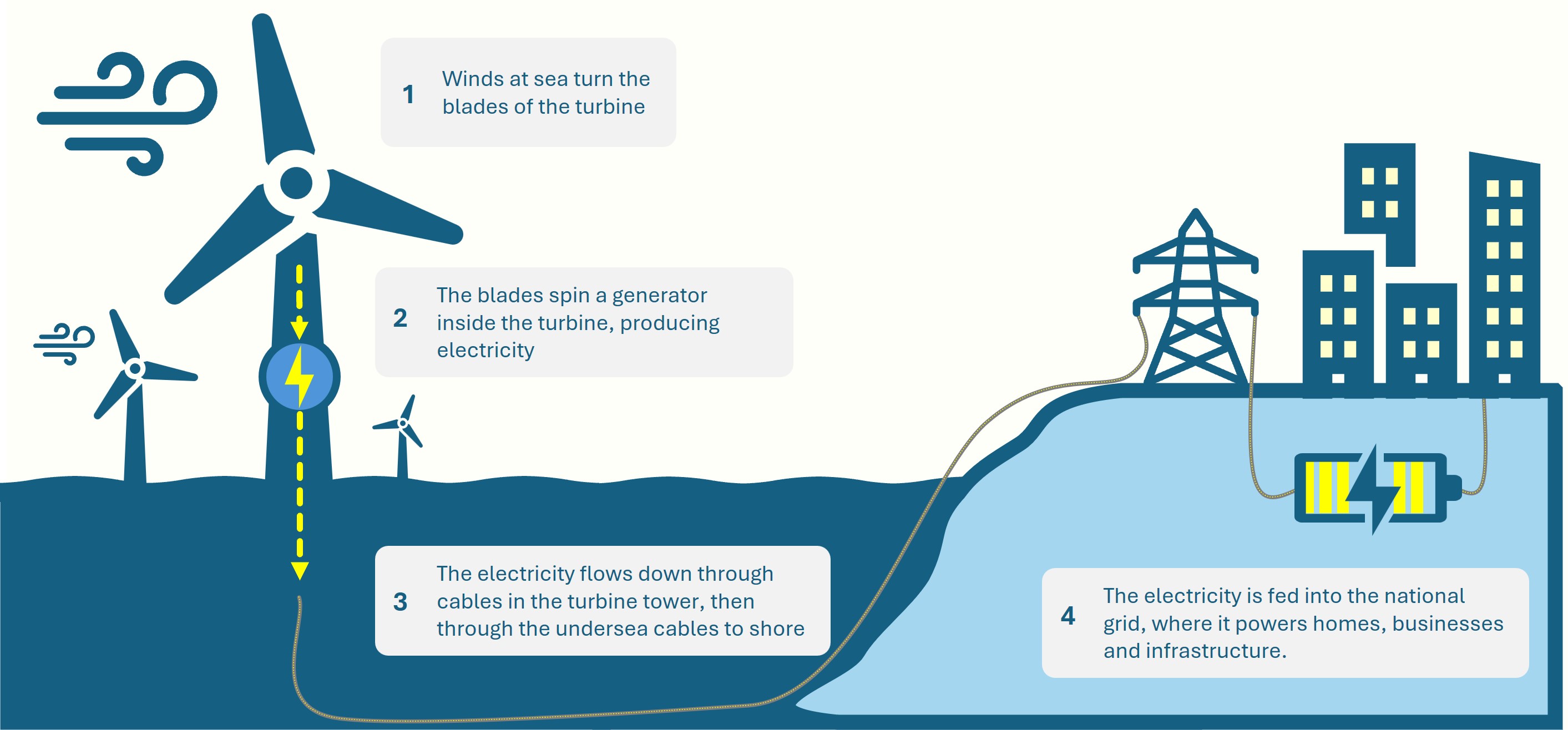
Text description of graphic: How wind turbines work
Why New Zealand is well suited to offshore renewable energy
New Zealand has excellent conditions for offshore wind farms due to high average wind speeds. The country also has one of the world's largest Exclusive Economic Zones, an area of sea in which it has exclusive rights regarding the exploration and use of marine resources, including energy production from water and wind.
How the offshore renewable energy regime interacts with other legislative regimes
The offshore renewable energy regime has been designed to operate alongside other legislative regimes that govern the use, management and protection of New Zealand’s marine resources and marine environment. An overview of the offshore renewable energy regime can be found on the following webpage.
Overview of the offshore renewable energy regime
Developers that hold either a feasibility permit or a commercial permit under the offshore renewable energy regime are required to obtain relevant consents under other regimes (e.g. the Resource Management Act 1991) to carry out certain feasibility activities and to develop ORE infrastructure. Only holders of a feasibility or commercial permit are able to apply for consents related to ORE infrastructure.
Protecting marine ecosystems
When planning and developing offshore renewable energy infrastructure, developers will be expected to adopt international best practices to assess, protect and even enhance marine ecosystems and biodiversity.
The feasibility permit period gives developers time to study potential environmental impacts and find ways to reduce them.
Developers will be required to obtain the necessary resource or marine consents before they can develop ORE infrastructure.
Economic and investment potential
Energy resilience
Offshore wind farms generate renewable electricity on a large scale and more consistently than other options.
Economic growth and regional development
Experience from overseas is that offshore renewable energy projects can support economic growth and regional development, both during their development and once they are operational. Overseas examples show that these projects also have the potential of enabling existing industries to decarbonise and expand, while also encouraging future-focused industries to establish themselves in New Zealand.