
From satellite data to search and rescue: an emerging researcher’s journey
When Ella Fasciana joined the Synthetic Aperture Radar for Search and Rescue (SAR4SAR) project, as an emerging researcher at the University of Auckland, she wasn’t planning a career in search and rescue. She was looking for a research challenge that let her solve problems, create practical solutions, and make a meaningful difference.
On this page I tēnei whārangi
That difference matters in New Zealand, where we’re responsible for search and rescue across 1 of the largest maritime areas in the world. When someone is lost at sea, time is critical - and knowing where to focus a search can make all the difference.
This Catalyst-funded SAR4SAR project explores how space-enabled satellite radar data can help narrow search areas during maritime search and rescue operations.
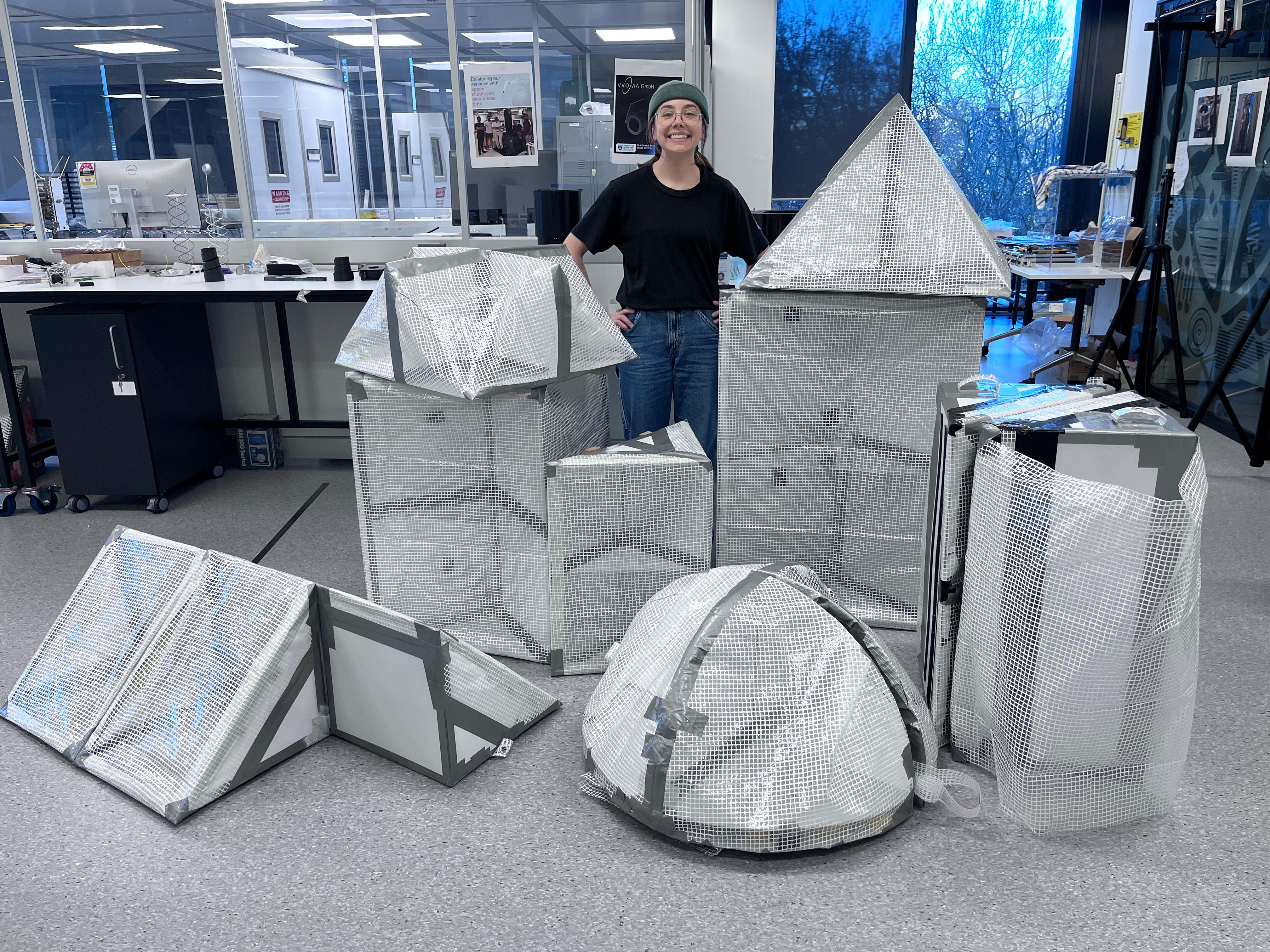
Ella Fasciana stands in the University of Auckland Space Institute, Fabrication and Assembly Facility surrounded by the full range of SAR4SAR Phase 2 prototypes, prior to testing in Omaha Bay, NZ.
It’s being delivered by the University of Auckland and their startup ‘Seascape’, with support from New Zealand Defence Science and Technology, and in partnership with the United States Indo-Pacific Command (US INDOPACOM) and Umbra Space, whose support has enabled field testing, international collaboration, and community engagement.
MBIE’s Catalyst Fund enables international science collaborations that build capability, strengthen partnerships, and deliver tangible benefits for New Zealand, including access to global expertise and data.
By improving how potential targets are identified in challenging ocean conditions, the research aims to reduce the time and uncertainty involved in searching vast areas of sea.
Unlike optical imagery, which can be limited by cloud cover and low light, synthetic aperture radar can detect objects across a wider range of environments. The project is also investigating low cost reflector technology that could make vessels easier to detect using existing satellite systems.
From the outset, the research has been shaped by real world end users - including remote island communities and fishermen who may not always have access to traditional distress beacons.
The aim is to develop technology that complements existing safety tools and provides an additional option for improving safety at sea.
Later this year, planned engagement with communities in the Marshall Islands will help test how this technology could work in practice, while ensuring it remains grounded in real world need.
For Ella, success isn’t just about the technical outcome. “I’m a big believer in the idea of leaving things better than you found them,” she says. “Knowing that this research could help someone return home safely would be a huge success for me.”
Working on SAR4SAR has also shaped Ella’s development as an emerging researcher - building on her confidence and willingness to seize opportunities, while showing how research can move beyond the lab into real world application.
“It’s been incredible to work on something with real world impact and the potential to grow far beyond what I first imagined,” she says.
“New Zealand’s compact, collaborative ‘give it a go’ research culture has been a big part of making that possible.”
“At university, you never really know what a conversation or a cold email about research opportunities might lead to,” she says.
“Those opportunities can grow into something much bigger than you expect.
University of Auckland Senior Lecturer Thomas Dowling cites Ella’s combination of practical engineering ability and environmental science as being integral to her success in tackling the formidable challenge of improving safety at sea.
“Making ideas real, proving them, and then convincing others that they are actually a good idea, is hard,” says Thomas.
“We succeeded because of Ella's innovation, insight and hard work. I’m looking forward to seeing her take on the next challenge in our journey towards saving lives and making a difference to both New Zealand and the wider Pacific."
This project supports the New Zealand Space and Advanced Aviation Strategy objective to develop sovereign space capability by advancing domestic SAR technologies and IP anchored in New Zealand.