
What is geothermal and how is it important to New Zealand?
Our unique geology provides New Zealand with an extraordinary opportunity to harness a powerful and versatile natural resource with diverse applications. Stunning vistas showcasing precious geothermal surface features, combined with early innovation in energy development, laid the foundation for New Zealand’s energy profile and propelled us forward as a global leader.
On this page I tēnei whārangi
A long used taonga
Geothermal fluid, or waiwhatu (derived from the te reo Māori words wai (water, fluid) and whatu (stone, core) to mean ‘fluid from the core’),[1] is considered a living entity and a taonga by tāngata whenua. Geothermal sites hold particular cultural and spiritual significance for Māori as the places where the physical and spiritual worlds meet and are woven through the whakapapa and pūrākau (myth, ancient legend) of many iwi and hapū. Māori have used geothermal features for cooking, bathing, therapeutic and heating purposes for centuries. Māori have also utilised geothermal features for tourism business and other development purposes, carried out in accordance with tikanga (customs, traditional values). These uses are still practiced today.
Geothermal energy comes from deep within the Earth’s crust, where magma (tokarewa)[2] heats surrounding rocks and water to extremely high temperatures in reservoirs (māpuna)[3] deep underground. The water and steam from geothermal reservoirs can rise to the surface, causing geysers, hot springs (ngāwhā), boiling mud pools and sinter terraces.[4] New Zealand has many globally significant geothermal surface features which are phenomenal tourism attractions and notable contributors to export earnings and regional economies.
New Zealand’s geographic location gives us a unique geothermal advantage. Particularly in the Taupō Volcanic Zone (TVZ), the Earth’s crust has stretched and thinned, allowing us to access significant geothermal resources and heat at much shallower depths.
In 2024, 27.5 per cent of international visitors reported experiencing a geothermal attraction while in New Zealand.[5]
A surge in development
Modern geothermal development in New Zealand began in the 1950s. A Crown-led explorative drilling programme between 1949 and 1986 jumpstarted our understanding of the geothermal fields in the TVZ and at Ngāwhā in Northland. This work established the potential for electricity generation in these areas, utilising geothermal steam to power turbines.
New Zealand’s first, and the world’s second, geothermal power station was Wairākei, just outside Taupō, which first generated electricity in 1958. It is still operating nearly 70 years later and is now one of 17 geothermal power plants across eight geothermal fields – delivering a combined generation capacity of over 1,200 MW.[6] Unlike wind and solar, geothermal energy is consistently available.[7]
In 2024, geothermal accounted for 8,741 GWh, or nearly one-fifth of New Zealand’s annual electricity generation.[8]
Lessons from the past
Not all geothermal development has had a positive impact. This strategy acknowledges the damaging environmental effects, including land subsidence and the loss of many high-value and culturally significant surface features such as geysers, that occurred at Wairākei as a direct result of the development of the Wairākei geothermal power station. Over-extraction of the Rotorua geothermal system in the 1960s and 1970s led to depletion of geysers and other surface features. Regional councils, together with input and mātauranga from local iwi and hapū, have taken the lessons from the past and helped to create strong consenting processes to support the sustainable development of geothermal resources.
Partnering with tāngata whenua is an integral component of geothermal development, bringing a rich blend of economic insight, Māori development priorities and values to the forefront. This partnership enables Māori, as kaitiaki, to actively shape the future and catalyse innovation across the industry.
Case study 1: Decarbonising the covered crop industry
Innovative projects supported by the Ministry for Primary Industries’ Sustainable Food and Fibre Futures Fund (SFFF Fund)* are exploring ways to replace fossil fuels with renewable geothermal inputs. These projects seek to address key barriers to decarbonisation in horticulture while enhancing energy and food security.
The Geothermal Food Systems project led by Upflow in collaboration with Tauhara North No.2 Trust integrates geothermal heat, electricity and CO2 capture to create a low-carbon, self-sufficient growing environment for glasshouses. This initiative is progressing towards a demonstration-scale deployment to validate and optimise this innovative technology package for wider use across New Zealand.
Earth Sciences New Zealand, Vegetables NZ, Tomatoes NZ and GeoExchange NZ are working together to develop a web-based tool that translates complex subsurface data into accessible insights. This tool will help greenhouse growers in Auckland, Waikato and Bay of Plenty assess and adopt low-temperature geothermal heating to support the horticulture sector’s shift away from fossil fuels toward 24/7 renewable energy.
* The SFFF Fund has been replaced by the Ministry for Primary Industries’ Primary Sector Growth Fund.
Beyond electricity generation – the geoheat opportunity
The potential of our geothermal resources does not end at electricity generation. In Kawerau and Taupō, renewable geothermal heat and steam powers industrial processes, such as timber drying and tissue manufacturing. In 2024, direct use of geothermal energy (across industrial, agricultural, commercial and residential sectors) amounted to 7.38 PJ, with an additional 0.56 PJ[9] used for co-generation.[10]
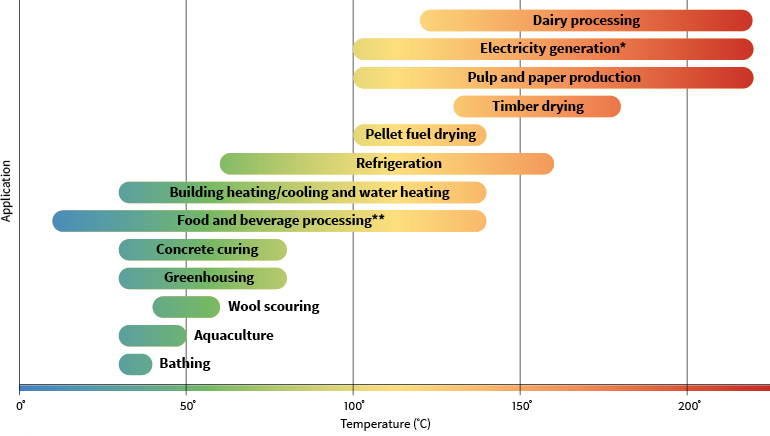
The full spectrum of geothermal heat can be used in a variety of applications – including bathing, aquaculture, horticulture and heating for water and buildings (see Figure 1). This strategy seeks to incorporate all these opportunities, including electricity generation and geothermal and non-geothermal direct heat use, and uses the term ‘geoheat’ to capture these wider applications.[11]
Figure 1: Examples of uses across the geothermal heat spectrum (underlying data provided by Earth Sciences New Zealand)
Note:
*This includes honey and meat processing, and fruit and vegetable dehydration
** This is the turbine inlet temperature range
Image description
Case study 2: Beyond heat and steam - innovative resource recovery from geothermal fluids
Ground-breaking science and innovation pioneered in New Zealand is enabling greater value to be recovered from New Zealand’s geothermal resources. The novel Biofeedstocks project, delivered by Upflow and co-funded by Tauhara North No.2 Trust and the SFFF Fund, is pioneering the use of geothermal waste gases (CO2 and methane) and microorganisms to produce high-protein biomass, with potential applications in animal feed, human nutrition and high-value bioproducts.
Contact Energy are actively exploring capturing and refining geothermal CO2 from Ohaaki geothermal power station near Taupō to produce food-grade CO2 for the food and beverage industry.
Unleashing subsurface value
Beneath the surface lies further commercial potential – from extracting the valuable minerals in geothermal fluids to capturing geothermal CO2 for various commercial uses to pioneering biotechnology that leverages the stability of geothermal extremophiles, microorganisms that thrive in very hot and acidic environments.
These innovations open new economic pathways and position geothermal as a source of scientific advancement, environmental stewardship and industry transformation, while also unlocking opportunities to export the intellectual property (IP) generated by these discoveries.
Powering partnerships – geothermal collaboration across borders
New Zealand’s geothermal expertise is recognised globally, contributing to renewable energy development and building sector capability worldwide. Strategic partnerships with countries such as the United States, Japan and Iceland strengthen trade relationships and provide access to international technology and expertise, supporting the next phase of geothermal advancement.
Cooperation agreements with the Philippines and Indonesia enable New Zealand’s commercial sector to access new markets and support global renewable energy ambitions through technical assistance and capacity building. New Zealand also works with regional institutions in Africa and the Caribbean to help develop geothermal sectors in these regions.
Case study 3: From challenge to commodity
Geo40 and CaSil Technologies have developed innovative processes and technologies to address the world-wide problem of silica deposition that affects geothermal resource utilisation by blocking pipes and reinjection wells, leading to decreased well lifespan and power station energy efficiency. Geo40 recovers valuable colloidal silica at full commercial scale from geothermal fluids at Ohaaki power station, improving the utilisation of geothermal heat while also unlocking new revenue streams by selling the captured high-quality geothermal colloidal silica nanoparticle for use in a myriad of applications. Geo40 is also developing technology that will create low-carbon, sustainable sources of globally strategic minerals from geothermal fluids, including lithium, boron and caesium.
CaSil Technologies, supported by the Ministry of Business, Innovation and Employment’s Endeavour Fund, has developed technology to rapidly capture the silica from geothermal fluids and transform it into a nanostructured calcium silicate (CaSil) material with novel applications as a smart fertiliser. The technology has been successfully demonstrated at pilot plant scale operations in four New Zealand geothermal power stations.
Case study 4: A world leader in geothermal research and training
New Zealand is driving international geothermal innovation and capability building as a global leader in geothermal energy and science. The Geothermal Institute at the University of Auckland is a world-leader in geothermal education, engineering and reservoir modelling. The Institute consults on commercial geothermal projects in over 40 countries and has trained over 2,000 energy professionals worldwide since 1978 through specialised post-graduate programmes and professional training.
Government-funded research programmes led by Earth Sciences New Zealand (ESNZ) have spearheaded New Zealand’s bold ambitions in supercritical/superhot geothermal exploration, while continuing to develop our understanding of New Zealand’s low enthalpy and conventional geothermal resources. ESNZ’s geothermal expertise has supported the global geothermal industry for over 50 years.
Sustainable development
Advances in reinjection technology are enhancing the sustainability profile of geothermal energy. In addition to being reliable and renewable, geothermal can now offer low-carbon electricity generation, as the naturally occurring greenhouse gases in geothermal fluids can in some cases be returned to the reservoirs or alternatively captured for use in secondary applications, rather than released to the atmosphere.
Supercritical/superhot geothermal – the next frontier
New Zealand’s conventional geothermal reservoirs (up to 350 °C and located between 1 km and 3.5 km deep) have long powered renewable energy, but the next chapter lies deeper – within the largely unexplored realm of supercritical/superhot geothermal fluids.[12] In the TVZ, our unique geology and thinner crust offer a rare opportunity to access geothermal fluids at depths beyond 5 km and temperatures exceeding 400 °C. These supercritical/ superhot resources could deliver up to three times more energy than conventional systems.[13]
Backed by government investment, this bold exploration into uncharted subsurface territory could redefine our energy future and reinforce New Zealand’s global leadership in geothermal innovation.
Acknowledgement of Treaty and Treaty settlement obligations regarding geothermal resources
Geothermal resources are taonga of immeasurable cultural, spiritual, economic and historical significance to tāngata whenua. This strategy is developed in a context where iwi and hapū have rights and interests in geothermal resources and statutory acknowledgements in Treaty settlement legislation affirm the enduring significance of these taonga.
The Government, through this strategy, is committed to recognising and supporting the aspirations of iwi and hapū for the sustainable management, development and protection of geothermal resources. In doing so, the strategy seeks to uphold the Treaty and outcomes of Treaty settlements and to provide a pathway for ongoing partnership, meaningful engagement and shared benefit with tāngata whenua.
The strategy itself is intended to provide a coordinated framework and long-term vision for utilising the potential of New Zealand’s geothermal resources. There has been proactive engagement with iwi, hapū, and Māori organisations throughout the development of the strategy. Any future work to give effect to the strategy, including the development of new or amended policies, regulations or operational practices, will be undertaken through further policy processes. These processes will include consultation with iwi, hapū and sector participants as appropriate, and will ensure they have the opportunity to provide input on substantive policy proposals.
Acknowledgement of the ongoing Waitangi Tribunal inquiry (Wai 2358)
This strategy has also been developed in a context where the National Freshwater and Geothermal Resources kaupapa inquiry (Wai 2358), which began in 2012, is ongoing. We acknowledge this process and the perspectives being shared with the Waitangi Tribunal, including those on the draft strategy. As the Wai 2358 process continues, the Tribunal’s reporting will be considered as it is released.
Footnotes
[1] The Waiwhatu Project developed 6 te reo Māori kupu (words) to describe geothermal terms. More detail about this project and the other words:
Waiwhatu Project: Developing Shared Language(external link) — Geothermal The Next Generation
[2] A word developed by the Waiwhatu Project from the te reo Māori words toka (rock) and rewa (to melt, to become liquid).
[3] A word developed by the Waiwhatu Project from the te reo Māori word māpuna, meaning ‘to well up, to form a pool’.
[4] Sinter terraces are silica deposits formed as silica precipitates out of geothermal fluid as it cools. The most famous sinter deposits were the Pink and White Terraces which were destroyed in the eruption of Mount Tarawera in 1886.
[5] From the Ministry of Business, Innovation and Employment’s (MBIE’s) 2024 International Visitor Survey.
[6] Capacity figure from Transpower’s ‘2025 SOSA – Final Supplementary Data – Final Version’ document:
Invitation to Comment: Security of Supply Assessment 2025 (Closed)(external link) — Transpower
[7] Geothermal power stations are occasionally shut down for periods of maintenance or upgrades.
[8] From MBIE’s ‘Data tables for electricity’:
[9] Direct use figure from MBIE’s ‘Energy balance tables’ spreadsheet:
[10] Co-generation means the use of geothermal energy to generate both electricity and heat.
[11] The Resource Management Act 1991 refers to geothermal as including geothermal energy derived from and produced within the Earth (for example from hot rock deep in the Earth) and ‘geothermal water’ as water heated within the Earth to a temperature of 30 °C or more. This resource can be used directly (for example for warm pool water or for space heating) or for electricity generation. In some cases, heat pumps are used to elevate (or reduce) temperatures to match the end use. This can include situations where the temperature of the energy source is less than 30 °C so is not technically considered geothermal (for example water that is 27 °C) or where ground source heat pumps use ambient heat from the ground for both heating and cooling. ‘Geoheat’ is a term used to encompass all of these applications.
[12] The term ‘supercritical geothermal’ describes a thermodynamic state of geothermal fluid at depth, where the fluid is neither a liquid nor a gas. This requires temperatures of greater than 375 °C and pressures of greater than 22 MPa. Internationally, the term ‘superhot’ is often used colloquially to refer to the same concept so has been included in this document alongside ‘supercritical’.
[13] Power prices are painful but geothermal could be New Zealand's superhot solution(external link) — GNS Science Te Pū Ao