
Unlocking the potential of RNA for New Zealand
From personalised cancer treatments to protecting native wildlife from emerging diseases, RNA technology could help solve some of New Zealand's biggest challenges.
On this page I tēnei whārangi
The RNA Platform is helping ensure New Zealand is not only using these technologies but also developing and manufacturing them here in Aotearoa.
Building capability
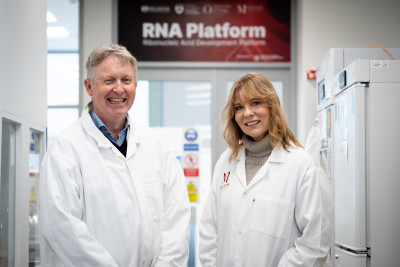
RNA Platform Co-Directors Professor Gary Evans (left) and Professor Kjesten Wiig
Established in 2023 with $70 million in Government funding over 7 years, the RNA Platform is building New Zealand's capability in RNA technologies and helping turn scientific discoveries into real-world products and solutions.
RNA, or ribonucleic acid, is a molecule found in all living cells that carries instructions for making proteins. Scientists can design RNA in the laboratory to create vaccines, medicines, diagnostics and agricultural technologies.
While RNA became widely known through COVID-19 vaccines, its potential extends far beyond pandemic response, says RNA Platform co-director Professor Kjesten Wiig, who leads the Platform alongside Professor Gary Evans.
"RNA technologies could help New Zealand respond more rapidly to biosecurity threats such as avian influenza and foot-and-mouth disease, develop more climate resilient agricultural systems, and support personalised medicines tailored to individual patients," says Wiig.
“Commercialisation takes years of R&D, but we’ve put the key pieces of the puzzle in place so promising projects can keep progressing.”
One of its first achievements has been addressing a major challenge for researchers – access to high-quality RNA. Previously, scientists often relied on overseas suppliers, facing high costs and long delays. Today, the Platform's production labs provide faster access to reliable and affordable RNA.
“We’ve gone from nothing to producing more than 1000 RNA products for research projects across New Zealand, Australia and the United Kingdom, supporting work on diseases like hepatitis and malaria, as well as animal health challenges such as bovine viral diarrhoea.”
From discovery to impact
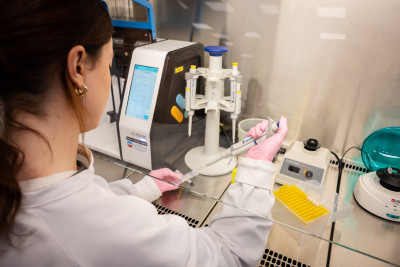
RNA Platform lab
The Platform is also helping innovative discoveries progress towards commercialisation. One of its most advanced projects is a portfolio of lipid nanoparticles, led by scientists at the Ferrier Research Institute. These tiny particles act as delivery vehicles, carrying RNA safely into the body. Producing them locally reduces reliance on expensive overseas suppliers while strengthening New Zealand's biotechnology capability.
Researchers are also advancing vaccine programmes targeting influenza and Staphylococcus aureus. Among the most ambitious is a universal influenza vaccine designed to protect against multiple flu strains. Wiig says discussions with international pharmaceutical companies are already underway.
Many promising discoveries fail to move beyond the laboratory because research processes do not easily translate into the manufacturing standards required for clinical trials and commercial products. The RNA Platform is helping overcome this challenge by bringing researchers and industry together from the outset. Through a close partnership with South Pacific Sera, manufacturing processes developed in the research environment can be adapted for commercial-scale production.
Future-proofing New Zealand
For Wiig, one of the Platform's most significant achievements is the capability being built for the future.
"We've developed sovereign capability. If another pandemic happened, New Zealand would now have the expertise, infrastructure and partnerships needed to respond much more quickly than before."
The RNA Platform is co-hosted by Te Herenga Waka Victoria University of Wellington and the University of Auckland, with support from the University of Otago and the Malaghan Institute of Medical Research.