
Organisational health and capability
During 2025/26, MBIE invested in the people, systems and technology needed to deliver its responsibilities and organisational strategy, Te Ara Amiorangi.
On this page I tēnei whārangi
The year also identified areas requiring further improvement, particularly in governance, investment oversight and organisational accountability. The work outlined below reflects both progress made during the year and priorities that will continue into 2026/27.
Strengthening governance and risk management
Effective governance underpins the delivery of MBIE's strategic objectives and helps maintain public trust and confidence. Mana Whakaruruhau, MBIE's enterprise governance system, brings together MBIE's senior leaders to provide clear direction, accountability and oversight, monitor performance and prioritise investment. They also provide assurance over services and organisational capability, to support timely, well-informed decisions.
During 2025/26, MBIE began strengthening organisational oversight and governance decision-making through changes to its governance frameworks and processes. Findings from the BCU project review reinforced the need for stronger governance and oversight of MBIE's investments and projects and prompted a wider review of the governance system. MBIE has refined its governance structures, clarified committee roles and responsibilities, and strengthened organisational reporting and insights. This better aligns strategic and operational decision-making with organisational performance, risk management and investment planning. Although further work is required, the changes made to date lay the foundation for stronger oversight, greater accountability and more effective support for the delivery of MBIE's long-term outcomes.
Good governance is complemented by effective risk management, which enables MBIE to navigate an increasingly complex operating environment while pursuing its strategic objectives. During the year, MBIE began implementing its refreshed enterprise risk framework across the organisation, improving the identification, management and monitoring of both strategic and operational risks.
The framework aims to support informed decision-making, help leaders understand risk interdependencies and strengthens organisational resilience and agility. MBIE's strategic risks focus on areas including emerging technologies, regulatory stewardship, financial stewardship, future workforce capability, trust and confidence and operational resilience. These are supported by a set of core operational risks managed through established controls, assurance activities and governance oversight.
Mana Whakaruruhau Governance Framework
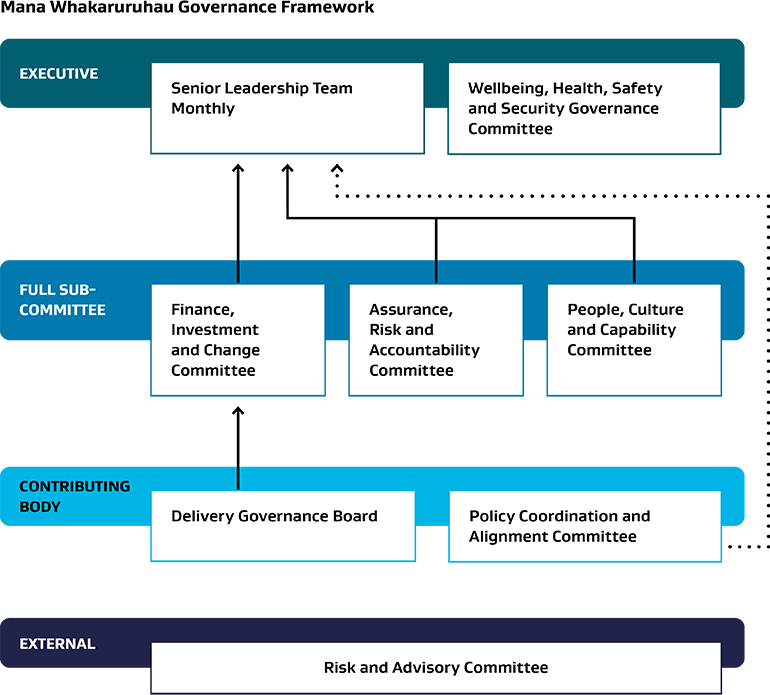
Text description for infographic – Mana Whakaruruhau Governance Framework
MBIE’s workforce reflects the diverse skills and experiences needed to deliver for New Zealanders
MBIE's people are central to delivering services, supporting government priorities and achieving the outcomes set out in Te Ara Amiorangi. The diversity of experiences, perspectives and skills across MBIE's workforce strengthens innovation, informed decision-making and organisational performance. As at 30 June 2026, MBIE employed 6,000 people (5,770 FTE). The following workforce profile provides a snapshot of MBIE's people and leadership demographics.
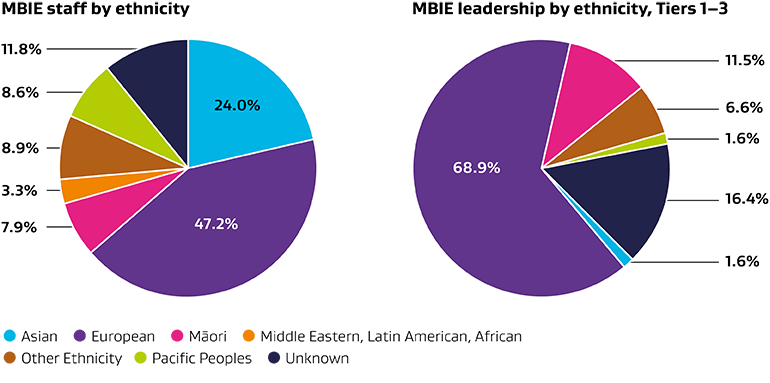
Note: Employees can identify with multiple ethnicities. As a result, the percentages shown do not total 100%.
Text description for infographic – MBIE staff and leadership by ethnicity
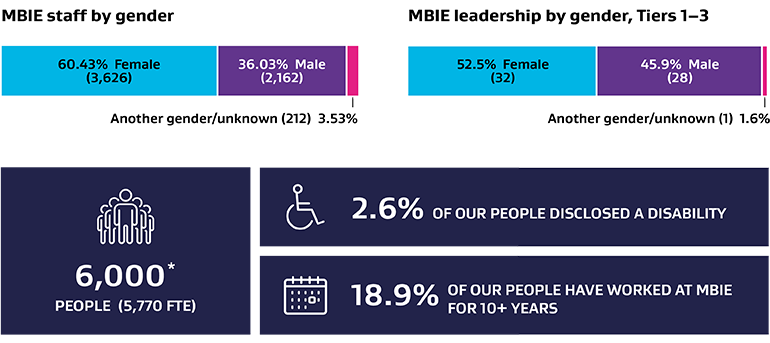
* Headcount totals include permanent and fixed-term employees and locally engaged staff. They exclude contractors, casual employees and employees on leave without pay or parental leave as at 30 June 2026.
Text description for infographic – MBIE staff and leadership by gender
Building leadership and workforce capability
During 2025/26, MBIE continued the Leadership at MBIE programme, which provides leadership expectations aligned with MBIE’s values, development pathways, masterclasses and resources through People Leader Home, an online portal for people leaders. The programme supports leaders to manage performance, lead through change and create effective working environments.
Leadership Expectations
Ngā Kawenga Ārahitanga
Lead by example
Whakatinana hei tauira
Enable our people
Whakaāhei ō tātou tangata
Deliver what matters
Whakatutuki ngā manako
MBIE also invested in technical, professional and role-specific learning. As at 30 June 2026, MBIE’s learning management system offered 685 courses. A particular focus was AI literacy. MBIE launched the AI Learning Hub with guidance and learning resources on the responsible use of AI. The AI Learning Video series recorded 454 completions during the year.
Improving delivery of Treaty commitments and relationships
MBIE continued to improve the management and delivery of Treaty settlement commitments, as per the Auditor-General's recommendations on public sector performance in meeting settlement obligations.
As at June 2026, 251 commitments across 63 settlements were recorded in Te Haeata Settlement Portal. Of these, 140 were completed, 103 were on track, 2 had not yet been triggered and 6 had delivery issues. Most recorded commitments relate to Crown minerals and natural resources.
During the year, MBIE improved the tracking and reporting of commitments and coordination between teams. MBIE also supported 22 settlement negotiations and continued post-settlement engagement with iwi. This included engagement under the Energy and Resources Accords and the re-establishment of annual hui relating to some settlement commitments.
An internal review identified further opportunities to improve oversight, delivery and coordination and to respond to the Auditor-General’s recommendations. This work remains under way.
Strengthening Māori–Crown relations capability
MBIE continued to build the capability needed to engage effectively with Māori, understand Māori perspectives and support Māori aspirations. This work is supported by Whāinga Amorangi and Te Ara Reo Rangatira, MBIE’s Māori Language Strategy.
During 2025/26, MBIE introduced learning on Te Tiriti o Waitangi and engagement with Māori, completed the first 2 phases of Whāinga Amorangi reporting and continued its te reo Māori learning programmes.
The October 2025 MyVoice survey found that:
- 68% of staff reported being comfortable and 9% confident in te reo Māori
- 55% reported being comfortable and 15% confident in tikanga and kawa
- 58% reported being comfortable and 27% confident in Te Tiriti o Waitangi and Aotearoa New Zealand history.
During the year, 46 staff completed te reo Māori learning through Te Whare Wānanga o Awanuiārangi, bringing total completions to 288. Te Ara Reo Rangatira is being refreshed to align with Te Ara Amiorangi and Maihi Karauna.
Supporting inclusion and belonging
A diverse and inclusive workforce is essential to MBIE's ability to deliver for New Zealanders. Kia Kotahi Mai: Together, We Belong, MBIE’s Inclusion and Belonging Strategy 2025–2028, sets the direction for creating an organisation in which people can participate and contribute. It is supported by annual planning and aligns with Kia Tū Ranga, MBIE’s pay-gap action plan and relevant public-sector frameworks.
During 2025/26, MBIE published its Workforce Diversity Action Plan 2026–27 and further aligned its inclusion and belonging and pay-gap work. Pay-gap results were mixed. As at June 2026, the gender pay gap was 12.6%, a decrease of 0.7 percentage points from the previous year. Māori and Asian pay gaps also decreased, while Pacific Peoples and Middle Eastern, Latin American and African (MELAA) pay gaps increased slightly:
- Gender: 12.6%, down 0.7 percentage points
- Māori: 3.2%, down 1.1 percentage points
- Pacific Peoples: 20.1%, up 0.5 percentage points
- Asian peoples: 17.9%, down 0.1 percentage points
- MELAA: 10.6%, up 0.3 percentage points.
Wellbeing, health, safety and resilience capability
MBIE continued to strengthen its wellbeing, health and safety system through governance, training, practical guidance and targeted support. Strategic oversight was provided through the Wellbeing, Health, Safety and Security Governance Committee. During the year, MBIE maintained its "Achieved" rating under ACC's Accredited Employers Programme. It recorded 26 work-related ACC claims (down from 50 in 2024/25) and no incidents requiring notification to WorkSafe New Zealand.
MBIE provided training and guidance to support safe working practices. During the year, 95 floor wardens, 161 first aiders and 91 workplace health and safety representatives were trained. The Safe Driving at MBIE module was completed by 98% of MBIE drivers and new fatigue-management guidance was introduced. Te Puna Ora, MBIE’s employee wellbeing hub, received more than 13,500 visits during the year.
Reported outcomes were mixed. Work-related ACC claims, injury and illness events, wellbeing events and critical risk events decreased, while near misses and violence and aggression events increased. These areas continue to be monitored.
MBIE also continued to strengthen emergency management and business continuity. During 2025/26, MBIE responded to 20 incidents, issued 27 organisation-wide alerts, participated in 44 cross-agency resilience activities and delivered incident management training to more than 370 staff, helping ensure readiness to respond to emergencies and maintain critical services for New Zealanders.
Advancing digital services and data capability
MBIE continued to leverage digital technology and data to support internal operations and deliver more efficient, effective and responsive public services.
During 2025/26, MBIE completed the digitisation of tenancy bond services and introduced pet-bond functionality. The system recorded 119,378 automated customer interactions from December 2025. MBIE also progressed the Our Future Services programme, transitioning international student visas and visas for family members of temporary visa holders to the enhanced Immigration Online platform.
Work continued to modernise registry platforms, maintain critical infrastructure and move services to cloud-based environments. More than half of MBIE’s existing services are expected to be migrated to the cloud by June 2027.
MBIE also expanded access to AI tools. Most staff had access to Microsoft Copilot Chat and just over 1,000 staff had access to Microsoft 365 Copilot. MBIE’s approach places emphasis on governance, safety and value. Further work will be needed to assess how these tools affect productivity, service delivery and business processes.
MBIE’s Data Strategy Te Mātahi continued to develop MBIE’s Cloud Data Platform and associated governance and data capability. Data migration supported priority work, including fuel-response activity and increased the range of information available through the platform. This provides a foundation for further migration, automation and analysis, while requiring continued attention to governance and data quality.
Reducing operational emissions and strengthen its approach to climate related risks and opportunities
MBIE is committed to improving operational efficiency and understanding, managing and responding to the actual and potential effects of climate change on its operations, strategy and investments. MBIE has a target to reduce its gross emissions by 46% by 2030 from a 2018/19 baseline.
During 2025/26, MBIE's total gross emissions were 4,709 tonnes of carbon dioxide equivalent (t CO₂-e), 52% below the 2018/19 baseline and 12% lower than the previous year. Initiatives included managing travel demand, increasing access to lower-emissions travel options, incorporating sustainability into property decisions, improving vehicle-fleet efficiency and considering emissions as part of procurement.
MBIE also continued to develop a system-based approach to identifying, assessing, managing and reporting climate-related risks and opportunities across the organisation.