
Overview of the offshore renewable energy regime
The offshore renewable energy regime is governed by the Offshore Renewable Energy Act 2026, which provides the legislative framework for the exploration and development of offshore renewable energy projects in New Zealand.
On this page I tēnei whārangi
The purpose of the regime is to:
- give developers greater certainty to invest in offshore renewable energy developments
- allow the selection of offshore renewable energy developments that best meet New Zealand’s national interests
- manage the risks to the Crown and the public from offshore renewable energy developments.
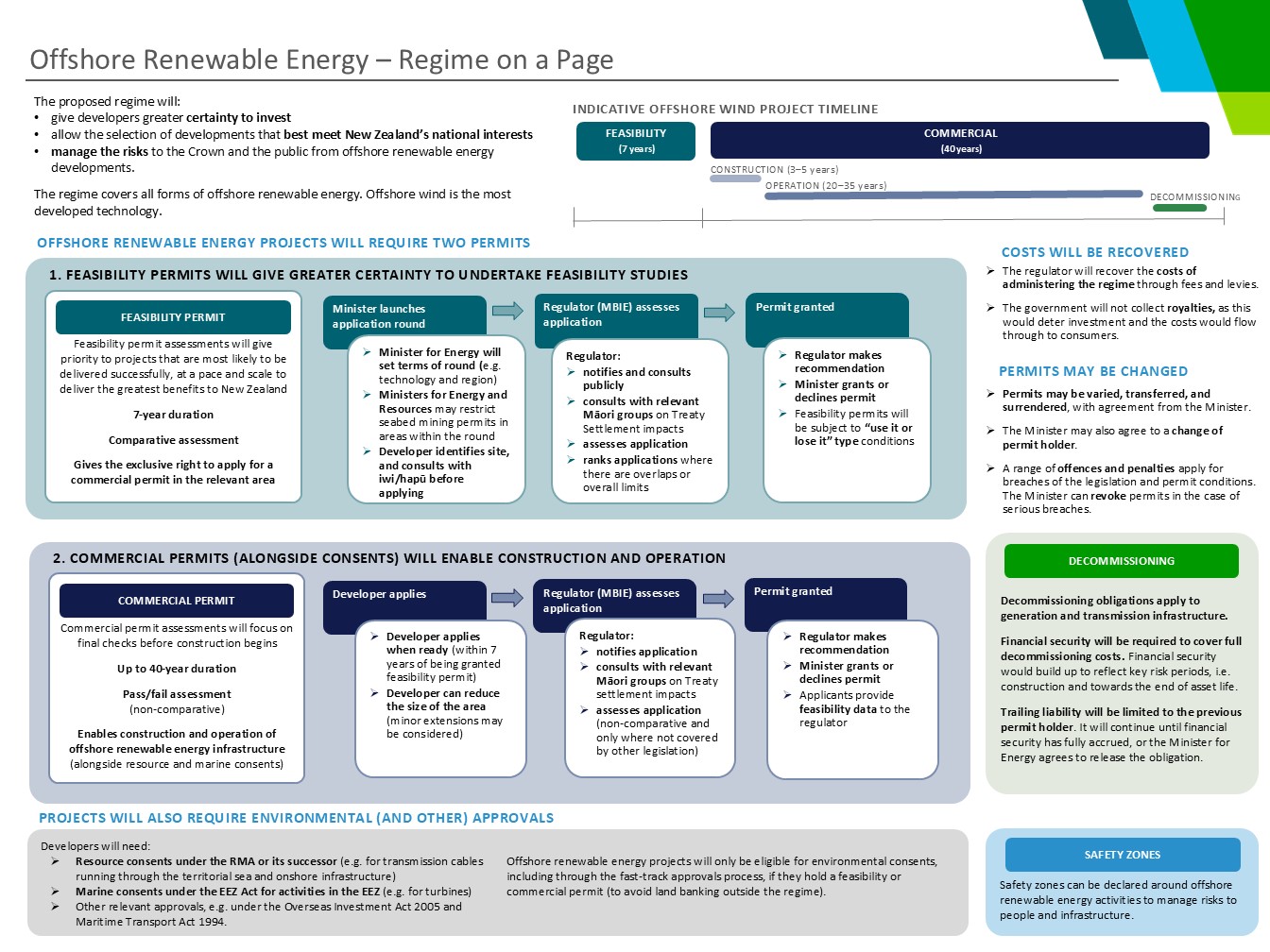
Text description of graphic: Offshore renewable energy - Regime on a page
Stages of the regime
The regime consists of a two-stage permitting system - feasibility permits and commercial permits, and is made up of 4 key stages:
- Feasibility – developers apply for a feasibility permit (7-year duration) and carry out activities to determine if their proposed project and proposed permit area is viable.
- Construction – if the project is viable, feasibility permit holders can apply for a commercial permit (up to 40-year duration) subject to relevant environmental consents and any other approvals to begin building and operating offshore renewable energy infrastructure.
- Operations and Maintenance – developers must continue to meet legal requirements, follow permit conditions, and complete annual reporting activities while the project is operating.
- Decommissioning – at the end of its life, developers and owners of transmission infrastructure are responsible for removing their infrastructure.
Stages of the regime: offshore renewable energy project
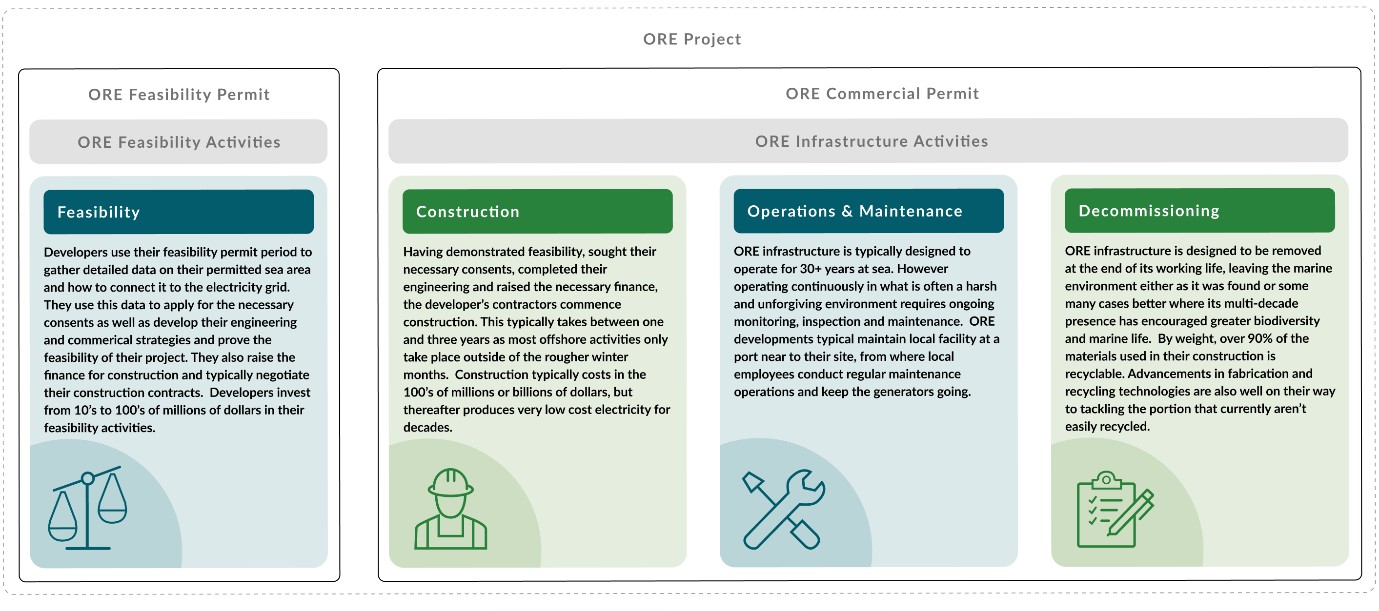
Text description of graphic: Stages of the regime: offshore renewable energy project
Feasibility permits
A feasibility permit provides developers an exclusive pathway to apply for a commercial permit for the same area in the future. This pathway provides developers with greater certainty over future development rights in the area for the construction of their offshore renewable energy project. This means developers are more likely to pursue offshore renewable energy projects, including carrying out feasibility studies on the area.
Applying for a feasibility permit
The Minister is responsible for launching application rounds, during which developers can apply for a feasibility permit.
In launching a round, the Minister will provide key details such as:
- opening and closing dates for applications
- eligible permit area locations
- permitted technologies.
The Minister for Energy is responsible for deciding whether to grant a feasibility permit to a developer.
Feasibility permit duration
Feasibility permits will be granted for 7 years. In exceptional circumstances, feasibility permits may be extended for up to an additional 7 years if specific criteria are met, in accordance with the Offshore Renewable Energy Act 2026.
Application fee and annual levy
Applicants for a feasibility permit will be required to pay an application fee when they submit their application. This fee helps recover the costs of assessing applications and administering the permitting process.
If a feasibility permit is granted, permit holders will also be required to pay an annual levy. This levy is divided among all feasibility permit holders and will help fund the ongoing administration, monitoring, and regulation of the offshore renewable energy regime.
What happens during the feasibility period
During the feasibility period, developers undertake activities to assess whether their project is technically, commercially, environmentally, culturally and socially feasible.
These activities may include:
- geotechnical and geophysical surveys
- wind speed measurements
- environmental and ecological impact assessments
- engineering and design studies
- economic analysis
- onshore and human impact studies, such as visual impact
- assessing grid connection options.
Further information
We will share more information soon about:
- the application process
- the assessment criteria
- how and when you can have your say on proposed offshore renewable energy developments.