
Overview of the feasibility permit application round
The application round for a feasibility permit involves 3 broad phases: application submission, MBIE’s assessment and consultation with iwi and the public, and Ministerial decision-making.
On this page I tēnei whārangi
The processes described below apply to the current application round as listed in Offshore Renewable Energy Feasibility Permit Application Round Notice – ORE-RN-2026-001. Future application rounds may be subject to different requirements, processes, or timeframes.
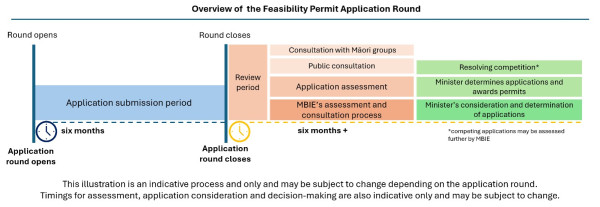
Overview of the Feasibility Permit Application Round
Once the period for receiving applications closes, applications are checked for completeness and reviewed to ensure they meet relevant requirements of the Offshore Renewable Energy Act 2026 (Act) and Offshore Renewable Energy Regulations 2026. Applications that proceed beyond this review will then be assessed in accordance with the Act and Regulations. During this time, MBIE will also carry out public and Māori consultation on applications. Once the assessment and consultation phase is complete, the Minister determines the outcome of applications. If there are competing applications in an application round, the Minister may do any or all of the following actions set out in section 19 of the Act. For example, in instances of permit area overlap, this may involve inviting all or any of the applicants to revise their application to resolve the competition for the same permit area.
Assessment and Ministerial decision-making timeframes will depend on the number and complexity of applications received. A standard assessment process is expected to take approximately 6 months after the application submission period closes.
Assessment criteria
Applications will be assessed against the requirements set out in the Act, Regulations, and the terms of the round notice. This includes consideration of:
- the likely benefits of the proposed development for New Zealand
- whether the proposed development plan is consistent with the purpose of the permit, the Act, and good industry practice
- the applicant's technical and financial capability to undertake the proposed activities
- the applicant's ability to comply with the requirements of the legislative framework on an ongoing basis
- the applicant's compliance record, including environmental track record
- the applicant’s consultation undertaken with relevant Māori groups
- the potential impacts on Māori rights and interests
- the applicant's approach to identifying, engaging with, and managing existing rights and interests in the proposed permit area
- submissions received through the public consultation process
- any national security or public order risks associated with the application
- any other matters specified in the Regulations or the terms of the application round.
Feasibility permits are one stage of a 2-stage permitting system under the offshore renewable energy regime. You can find information about the regime and how it supports the development of offshore renewable energy in New Zealand here: